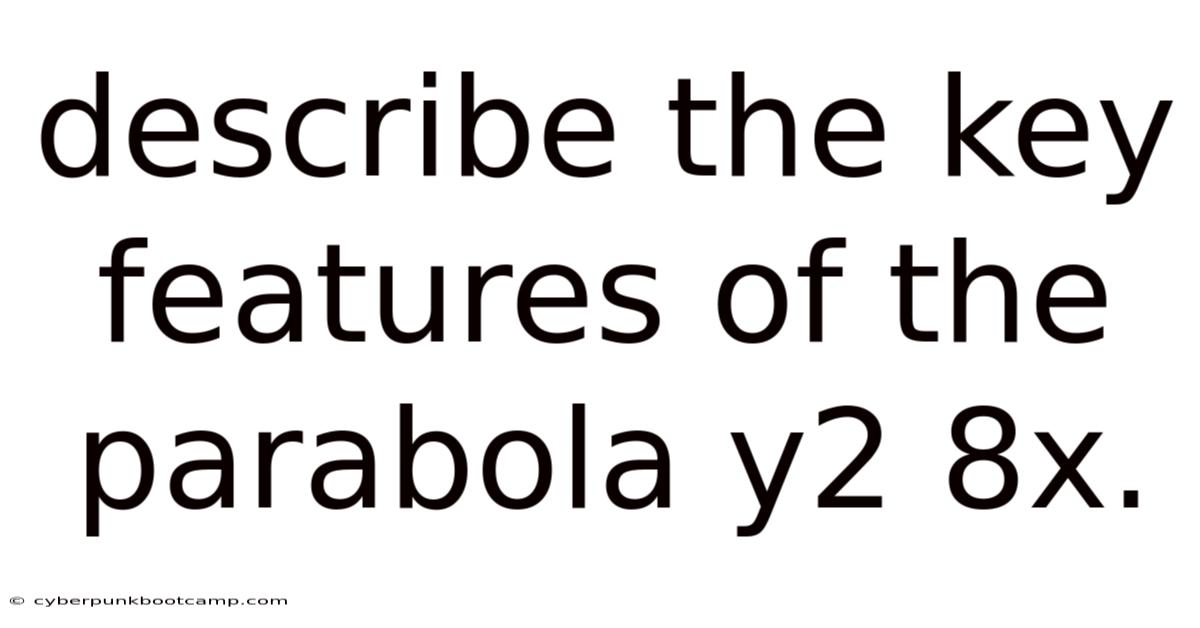
Key Features of the Parabola (y^2 = 8x)
The key features of the parabola (y^2 = 8x) include its vertex, axis of symmetry, focus, directrix, latus rectum, intercepts, domain, range, and general shape. This equation represents a horizontal parabola that opens to the right and can be analyzed by comparing it with the standard form (y^2 = 4ax). Understanding each feature helps in sketching the graph, solving geometric problems, and interpreting the relationship between the coordinates of points on the curve Worth keeping that in mind. Which is the point..
Standard Form of the Parabola
The standard equation of a horizontal parabola is
[ y^2 = 4ax, ]
where:
- (a) represents the distance from the vertex to the focus.
- The vertex is located at the origin, ((0,0)).
- The axis of symmetry is the (x)-axis.
- The parabola opens to the right when (a>0).
For the equation
[ y^2 = 8x, ]
we compare the coefficient of (x) with (4a):
[ 4a = 8. ]
Because of this,
[ a = 2. ]
Since (a=2), the parabola has a focal length of (2) units and opens in the positive (x)-direction.
Vertex and Axis of Symmetry
The vertex is the point where the two branches of the parabola meet. For a horizontal parabola in the form (y^2=4ax), the vertex is always at
[ (0,0). ]
Thus, the vertex of (y^2=8x) is
[ \boxed{(0,0)}. ]
The axis of symmetry is the line that divides the parabola into two matching halves. Because the equation contains (y^2) and no (x^2), the symmetry is across the (x)-axis:
[ \boxed{y=0}. ]
If a point ((x,y)) lies on the parabola, then ((x,-y)) also lies on it. Take this: when (x=2), the equation gives (y^2=16), so the points ((2,4)) and ((2,-4)) are symmetric about the (x)-axis The details matter here..
Direction of Opening
To determine the direction in which the parabola opens, write the equation as
[ x=\frac{y^2}{8}. ]
Because (y^2) is always nonnegative, (x) cannot be negative. Also, as the magnitude of (y) increases, the value of (x) increases. This shows that the parabola extends indefinitely to the right.
Which means, (y^2=8x) is a horizontal parabola opening to the right. Its upper branch lies mainly in the first quadrant, while its lower branch lies mainly in the fourth quadrant.
Focus
The focus is a fixed point inside the parabola. For the standard form (y^2=4ax), the focus is
[ (a,0). ]
Since (a=2), the focus of (y^2=8x) is
[ \boxed{(2,0)}. ]
The focus lies on the axis of symmetry, two units to the right of the vertex. It is the point from which the distance to any point on the parabola can be measured It's one of those things that adds up..
A useful method for locating the focus is to substitute (x=2) into the equation:
[ y^2=8(2)=16, ]
so
[ y=\pm4. ]
This gives the endpoints of the latus rectum, not the focus itself
Directrix
The directrix is a fixed line that, together with the focus, defines the parabola. For the standard form (y^2=4ax), the directrix is the vertical line
[ x=-a. ]
Since (a=2), the directrix of (y^2=8x) is
[ \boxed{x=-2}. ]
The directrix lies on the opposite side of the vertex from the focus. Every point on the parabola is equidistant from the focus and the directrix, which is the fundamental geometric property of a parabola Less friction, more output..
Latus Rectum
The latus rectum is the line segment that passes through the focus and is perpendicular to the axis of symmetry, with its endpoints lying on the parabola. For the standard form (y^2=4ax), the length of the latus rectum is
[ |4a|. ]
With (a=2), the length of the latus rectum is
[ 4(2)=8. ]
To find the endpoints of the latus rectum, substitute (x=2) (the (x)-coordinate of the focus) into the equation:
[ y^2=8(2)=16, ]
so
[ y=\pm4. ]
Which means, the endpoints of the latus rectum are
[ \boxed{(2,4) \text{ and } (2,-4)}. ]
Sketching the Graph
With all key features identified, we can sketch the graph of (y^2=8x):
- Plot the vertex at the origin ((0,0)).
- Draw the axis of symmetry along the (x)-axis.
- Mark the focus at ((2,0)).
- Draw the directrix as a vertical line at (x=-2).
- Plot the endpoints of the latus rectum at ((2,4)) and ((2,-4)).
- Draw a smooth curve through the vertex and the latus rectum endpoints, opening to the right.
The parabola is symmetric about the (x)-axis and extends infinitely in the positive (x)-direction.
Applications
Parabolic curves appear frequently in physics and engineering. That said, the reflective property of parabolas—that rays parallel to the axis of symmetry reflect through the focus—makes them essential in the design of satellite dishes, headlights, and solar collectors. In projectile motion, the trajectory of an object under uniform gravity follows a parabolic path, making the analysis of such curves fundamental to understanding motion in two dimensions Took long enough..
And yeah — that's actually more nuanced than it sounds.
Conclusion
The equation (y^2=8x) represents a horizontal parabola with vertex at the origin, opening to the right with a focal length of 2 units. Day to day, by comparing it to the standard form (y^2=4ax), we determined that (a=2), which allowed us to identify all key features: the vertex at ((0,0)), the focus at ((2,0)), the directrix at (x=-2), and the latus rectum with endpoints at ((2,4)) and ((2,-4)). Understanding these characteristics provides a complete description of the parabola's geometry and enables accurate graphing and analysis of its properties Less friction, more output..
Parametric Representation
A convenient way to describe points on the parabola (y^{2}=8x) is through a parameter (t) (often called the parameter of the parabola). Setting
[ y = 2at,\qquad x = at^{2}, ]
with (a=2) gives
[ y = 4t,\qquad x = 2t^{2}. ]
Every real value of (t) yields a point ((2t^{2},,4t)) on the curve, and conversely each point on the parabola can be expressed uniquely in this form. This parametrisation is especially useful when dealing with families of chords or when computing curvature That's the part that actually makes a difference..
Derivative and Tangent Line
Differentiating the Cartesian equation implicitly,
[ 2y\frac{dy}{dx}=8 ;\Longrightarrow; \frac{dy}{dx}= \frac{4}{y}, ]
provided (y\neq0). At a generic point ((x_{0},y_{0})) on the parabola, the slope of the tangent is (m = 4/y_{0}). The equation of the tangent line can be written as
[ y_{0}y = 8\frac{x+x_{0}}{2}\quad\text{or}\quad y_{0}y = 4(x+x_{0}). ]
Using the parametric form, the tangent at the point corresponding to (t) simplifies to
[ ty = x + at^{2}, ]
which for (a=2) becomes
[ ty = x + 2t^{2}. ]
Focal Chord and Latus‑Rectum Properties
A focal chord is any chord that passes through the focus ((a,0)=(2,0)). If the endpoints of such a chord are given by parameters (t_{1}) and (t_{2}), the condition that the chord contains the focus is
[ t_{1}t_{2} = -1. ]
This means the product of the slopes of the two lines joining the focus to the endpoints equals (-1), confirming that the focal chord is orthogonal to the tangent at the vertex. The latus‑rectum itself is the special focal chord with (t_{1}=1) and (t_{2}=-1), yielding the endpoints ((2,4)) and ((2,-4)).
Curvature and Radius of Curvature
The curvature (\kappa) of a plane curve given by (y^{2}=8x) can be expressed in terms of the parameter (t). For a parametrisation ((x(t),y(t))),
[ \kappa = \frac{|x' y'' - y' x''|}{\bigl(x'^{2}+y'^{2}\bigr)^{3/2}}. ]
Computing the derivatives for (x=2t^{2},; y=4t) gives
[ \kappa(t)=\frac{8}{\bigl(4t^{2}+16\bigr)^{3/2}} = \frac{8}{4^{3/2}(t^{2}+4)^{3/2}} = \frac{1}{(t^{2}+4)^{3/2}}. ]
The radius of curvature (\rho = 1/\kappa) is therefore
[ \rho(t)= (t^{2}+4)^{3/2}. ]
At the vertex ((t=0)), (\rho = 8), which matches the known radius of curvature for a parabola at its vertex.
Applications in Optics and Engineering
The reflective property of a parabola—any ray parallel to the axis of symmetry is reflected to the focus—underpins many technologies. In satellite dishes, the incoming signals travel parallel to the axis and converge at the focus where the receiver is placed, maximising signal strength. Also, in headlights, a light source positioned at the focus emits rays that leave the dish parallel, producing a directed beam. Solar collectors exploit the same principle: sunlight striking the parabolic surface is concentrated at the focus, raising temperatures efficiently.
Most guides skip this. Don't.
Beyond optics, the parabola’s shape appears in suspension bridges, where the main cable assumes a parabolic arc under uniform horizontal loading, and in projectile motion, where the trajectory of a projectile near Earth’s surface (ignoring air resistance) follows a parabola.
Practice Problems
- Find the equation of the tangent to (y^{2}=8x) that passes through the point ((0,5)).
- Determine the length of the focal chord whose endpoints have parameters (t_{1}=2) and (t_{2}=-1/2).
