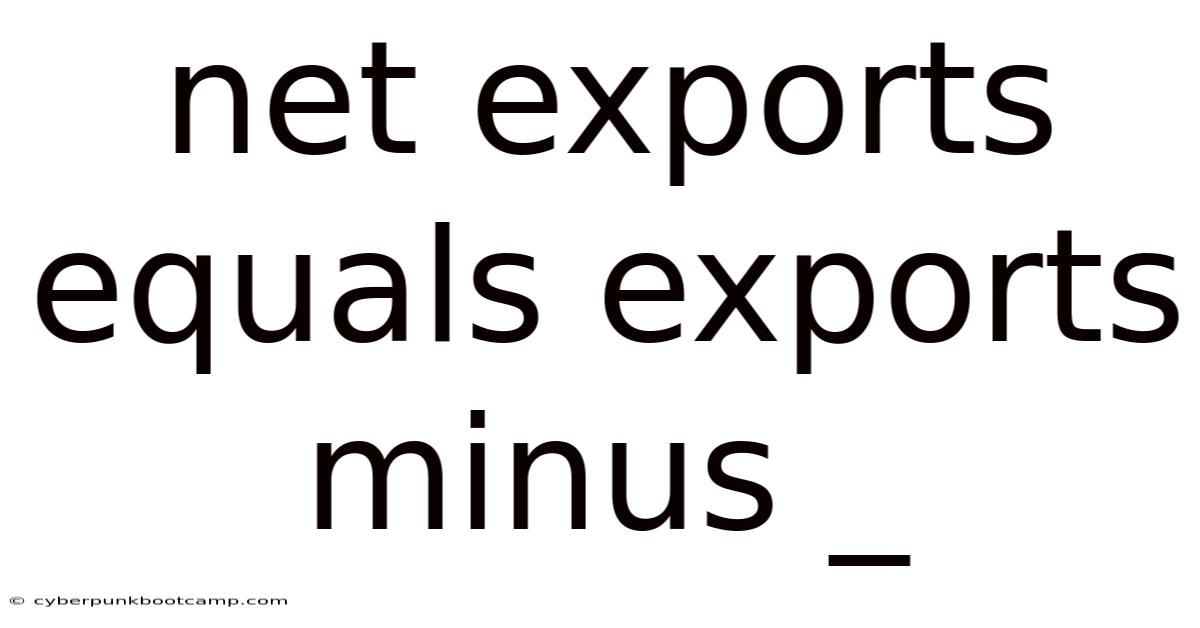
Net exports equals exports minus imports, a simple yet powerful formula that lies at the heart of a nation’s trade balance. But in this article we will explore what net exports mean, how the calculation works, the components that drive each side of the equation, and why understanding this relationship matters for policymakers, businesses, and everyday citizens. By the end, you will have a clear, comprehensive view of how net exports fit into the broader picture of economic activity and international commerce Worth keeping that in mind..
This changes depending on context. Keep that in mind.
Introduction
The phrase net exports equals exports minus imports is more than just a textbook definition; it is a snapshot of a country’s ability to sell goods and services abroad while purchasing from other nations. Practically speaking, conversely, when imports outpace exports, the figure turns negative, signaling a trade deficit. When a country’s exports exceed its imports, the result is a positive net export figure, indicating a trade surplus. This balance influences everything from currency valuation to employment levels, making it a critical metric for economic analysis.
Quick note before moving on.
How Net Exports Is Calculated
The Basic Equation
The core formula is straightforward:
Net Exports = Exports – Imports
- Exports refer to the total value of goods and services a country sells to other countries.
- Imports represent the total value of goods and services a country purchases from abroad.
The difference between these two flows determines the net export figure. A positive result means the nation is earning more from foreign sales than it spends on foreign purchases; a negative result indicates the opposite And it works..
Step‑by‑Step Calculation
- Identify Export Value – Sum the market value of all goods and services sold overseas during a specific period (usually a year or quarter).
- Identify Import Value – Sum the market value of all goods and services bought from other countries in the same period.
- Subtract Imports from Exports – Apply the formula to obtain net exports.
Take this: if a country exported $200 billion worth of goods and imported $150 billion, its net exports would be $50 billion, indicating a trade surplus of $50 billion.
Components of Exports
Exports are not a monolithic figure; they consist of several distinct categories:
- Merchandise Exports – Physical goods such as machinery, clothing, automobiles, and food products.
- Services Exports – Intangible offerings like tourism, financial services, software, and consulting.
- Primary Commodities – Raw materials and primary agricultural products that a country exports in large quantities.
Each component contributes differently to the overall export value, and understanding these categories helps policymakers target sectors for growth.
Components of Imports
Similarly, imports can be broken down into:
- Consumer Goods – Products purchased for personal use, ranging from electronics to clothing.
- Capital Goods – Equipment and machinery used in production processes, which can boost future productivity.
- Intermediate Goods – Materials used in the manufacturing of other goods that are later exported.
Recognizing these categories clarifies why a country may import certain items while still maintaining a healthy export profile Easy to understand, harder to ignore..
Why Net Exports Matter
Economic Growth Indicator
Net exports are a key component of a nation’s Gross Domestic Product (GDP) in the expenditure approach:
GDP = Consumption + Investment + Government Spending + Net Exports
A positive net export figure directly adds to GDP, stimulating economic growth. Conversely, a persistent trade deficit can dampen growth unless offset by other components Easy to understand, harder to ignore..
Currency Valuation
The trade balance influences exchange rates. A trade surplus often leads to currency appreciation because foreign buyers need the domestic currency to pay for exports. A trade deficit, however, can exert downward pressure on the currency, making imports cheaper and exports more expensive.
Employment and Industry
Export‑oriented industries tend to create jobs, both directly (in production) and indirectly (in logistics, services, and supply chains). A dependable net export figure can therefore lower unemployment and raise household incomes.
Factors Affecting Net Exports
- Exchange Rates – A weaker domestic currency makes exports cheaper and imports more expensive, potentially improving net exports.
- Global Demand – International economic conditions affect how eager foreign buyers are to purchase domestic goods.
- Trade Policies – Tariffs, quotas, and free‑trade agreements can either restrict or help with the flow of goods and services.
- Productivity and Innovation – Higher productivity reduces production costs, making exports more competitive.
Each of these factors can shift the balance between exports and imports, thereby altering the net export figure.
Net Exports in the International Trade Balance
When net exports equals exports minus imports, the result can be positive, negative, or zero. Even so, this figure is a cornerstone of the trade balance, which is part of the broader current account in a country’s balance of payments. A healthy current account, supported by positive net exports, signals that a nation can sustain itself internationally without relying heavily on external financing Most people skip this — try not to. Less friction, more output..
Common Misconceptions
-
“Net exports are the same as GDP.”
While net exports affect GDP, they are only one piece of the larger economic puzzle. -
“A trade deficit always harms the economy.”
Not necessarily; a deficit may reflect strong domestic consumption and investment, and it can be offset by inflows of capital or a strong service sector Which is the point.. -
“Only goods matter for net exports.”
Services exports (e.g., financial, tourism, digital services) now constitute a substantial share of many economies, especially in advanced nations.
Understanding these nuances prevents oversimplified interpretations of trade data.
Conclusion
Simply put, net exports equals exports minus imports, a concise formula that encapsulates a country’s trade performance. By dissecting the components of exports and imports, recognizing the economic implications, and considering the myriad factors that influence the balance, we gain valuable insight into how nations manage their international economic relationships. Whether you are a student, a business strategist, or a curious citizen, grasping this concept equips you to interpret trade data, anticipate market trends, and appreciate the interconnectedness of global commerce.
Of course. Here is a seamless continuation of the article.
The Practical Implications for Businesses and Policymakers
Understanding net exports is not merely an academic exercise; it has direct, tangible consequences for economic decision-makers at all levels.
For businesses, the net export balance is a critical barometer for strategic planning. A company in an export-oriented industry, such as manufacturing or specialized software, monitors global demand and exchange rate fluctuations to price its products competitively. Conversely, a firm that relies on imported raw materials must be acutely aware of trade policies and currency shifts that could impact its cost structure and profit margins. A sustained trend of growing net exports in a particular sector can signal a lucrative opportunity for expansion, while a persistent deficit might indicate a need to pivot, innovate, or seek new markets Worth knowing..
For policymakers and central banks, net exports are a primary lever for steering the national economy. Conversely, if the economy is overheating, a stronger currency (which typically reduces net exports) can help cool inflation by making imports cheaper and dampening excessive demand. When domestic demand is weak, a government might aim to boost net exports through measures like currency devaluation or export subsidies to stimulate growth and employment. Trade negotiations, too, are fundamentally centered on improving the net export position by reducing barriers and securing fair access for domestic industries abroad Most people skip this — try not to..
Looking Ahead: A Dynamic and Interconnected Future
The landscape of international trade is in constant flux, driven by technological advancements, geopolitical shifts, and evolving consumer preferences. The rise of digital services, the push for sustainable supply chains, and the increasing importance of regional trade blocs are all reshaping what constitutes an export and how value is created across borders.
In this dynamic environment, the fundamental equation of net exports = exports - imports remains the essential starting point for analysis. Even so, its real power lies in the deeper understanding it fosters. It reveals the strengths and vulnerabilities of an economy, highlights the flow of goods, services, and capital, and underscores the detailed interdependence of nations No workaround needed..
Conclusion
All in all, net exports serve as a vital pulse for any modern economy, reflecting a nation's ability to compete and connect on the global stage. In practice, by moving beyond the simple formula to appreciate the influencing factors, the common misconceptions, and the practical implications, we can demystify trade data. This knowledge is indispensable for navigating the complexities of the global marketplace, allowing us to make more informed judgments about economic health, policy choices, and the future of international commerce. The story of net exports is ultimately a story of global interconnection—a reminder that in an open world, economic fortunes are inextricably linked Less friction, more output..
