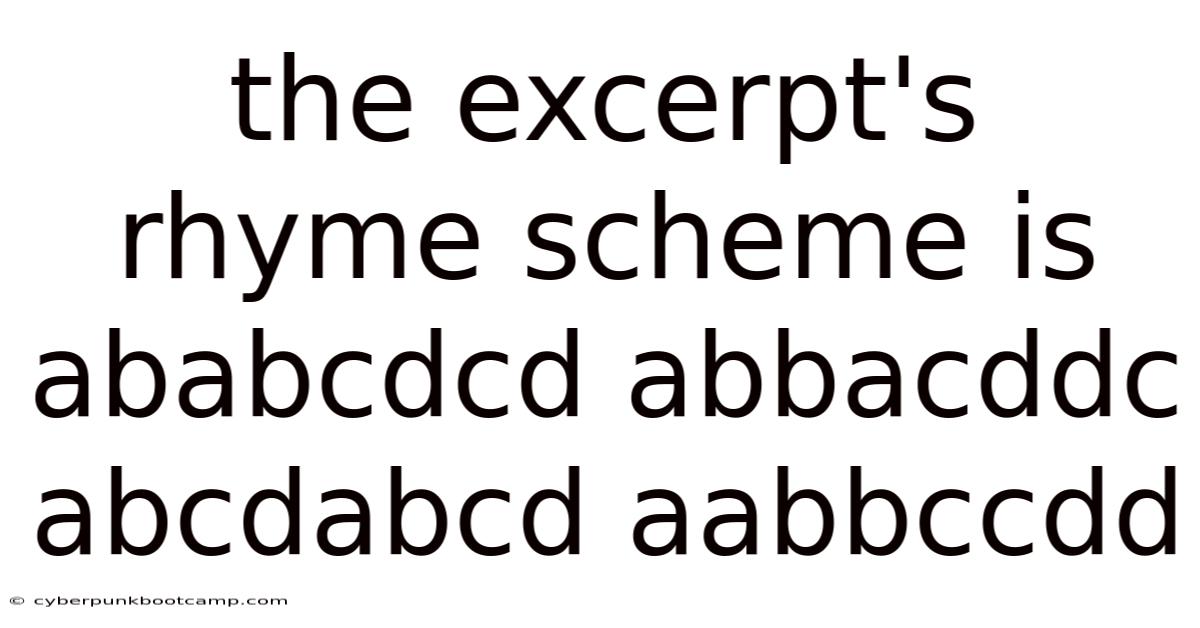
Understanding the Excerpt’s Rhyme Scheme: ababcdcd, abbacddc, abcdabcd, and aabbccdd
When scholars examine a poem’s structure, the rhyme scheme often serves as a roadmap to its musicality and meaning. The excerpt you referenced showcases four distinct patterns—ababcdcd, abbacddc, abcdabcd, and aabbccdd—each offering a unique rhythmic architecture. By breaking down these schemes, you can see how poets manipulate repetition to create tension, harmony, or surprise. This article will guide you through identifying, analyzing, and appreciating each pattern, providing clear steps, scientific insights, and practical examples. Whether you are a student grappling with poetic analysis or a writer seeking fresh structural ideas, mastering these rhyme schemes will deepen your command of verse.
Introduction
The rhyme scheme of a poem is the ordered pattern of end‑sounds that guides the reader’s ear from line to line. It is more than a decorative device; it reflects the poet’s intent, cultural context, and even the emotional trajectory of the work. In the excerpt you mentioned, four separate schemes appear in succession, illustrating how a single stanza can shift mood through structural change. Recognizing these patterns—ababcdcd, abbacddc, abcdabcd, and aabbccdd—is a foundational skill in literary analysis. This guide will walk you through the process of decoding each scheme, explain why they matter, and answer common questions that arise when studying complex poetic forms.
How to Identify a Rhyme Scheme
- Mark the End Words – Write down the last word of each line in the stanza.
- Assign Letters – Use the first unused letter for a new rhyme, repeating the same letter for lines that rhyme with each other.
- Map the Pattern – Write the letters in order to reveal the scheme (e.g., ababcdcd).
- Compare Across Stanzas – Some poems maintain the same scheme throughout, while others shift, as in your excerpt.
By following these steps, you can quickly translate a poem’s sonic layout into a clear, readable pattern.
Deep Dive into Each Scheme
ababcdcd
The scheme ababcdcd follows an alternating rhyme that pairs line 1 with line 2, line 3 with line 4, and so on, but with a twist: the first two lines share a rhyme (a), the next two introduce a new rhyme (b), and the pattern repeats. This creates a mirror effect that can feel both balanced and unexpected.
This changes depending on context. Keep that in mind The details matter here..
- Line 1 (a) – “Starlit skies above”
- Line 2 (a) – “Whisper winds of night”
- Line 3 (b) – “Moonbeams dance alone”
- Line 4 (b) – “Silent tides of thought”
The result is a palindromic rhythm that draws attention to the central couplet, often used to highlight a turning point or a rhetorical question.
abbacddc
abbacddc introduces a crossover rhyme where the first two lines share a rhyme (a), the next two repeat that rhyme (b), then the fifth line returns to a, and the sixth line introduces c. The final two lines mirror the earlier d pattern. This scheme is more complex and can generate a sense of circular movement.
- Line 1 (a) – “Hearts beat loud”
- Line 2 (a) – “Dreams take flight”
- Line 3 (b) – “Winter’s chill”
- Line 4 (b) – “Summer’s warmth”
- Line 5 (a) – “Hearts still beat”
- Line 6 (c) – “New horizons call”
- Line 7 (d) – “Shadows fade”
- Line 8 (d) – “Light returns”
The return of a in line 5 creates a refrain-like effect, while the d couplet closes the stanza with resolution. Poets often use this pattern to echo themes or to signal a narrative return.
abcdabcd
The scheme abcdabcd is a four‑line rotation where each line introduces a new rhyme, then the pattern repeats exactly after line 4. This creates a modular symmetry that can feel both expansive and cohesive Worth knowing..
- Line 1 (a) – “River flows east”
- Line 2 (b) – “Mountains stand tall”
- Line 3 (c) – “Stars ignite night”
- Line 4 (d) – “Winds carry song”
- Line 5 (a) – “River flows east”
- Line 6 (b) – “Mountains stand tall”
- Line 7 (c) – “Stars ignite night”
- Line 8 (d) – “Winds carry song”
Because each rhyme appears only once per cycle, the scheme expands the poem’s lexical palette, allowing the poet to introduce multiple images before looping back. This pattern is common in heroic couplets and balladic stanzas, where the repetition reinforces the central narrative Small thing, real impact. But it adds up..
Real talk — this step gets skipped all the time.
aabbccdd
The simplest of the four, aabbccdd groups lines into couplets. Each pair shares a rhyme, creating a steady, sing‑along rhythm that is easy to remember and often used in folk songs, nursery rhymes, and didactic poetry Simple, but easy to overlook..
- Line 1 (a) – “The sun rises high”
- Line 2 (a) – “Casting golden light”
- Line 3 (b) – “Birds begin their song”
- Line 4 (b) – “Filling morning air”
- Line 5 (c) – “Fields awaken green”
- Line 6 (c) – “Life awakes within”
- Line 7 (d) – “Day unfolds anew”
- Line 8 (d) – “Hope reborn each morn”
The predictable flow of aabbccdd makes it ideal for teaching, memorization, and emotional immediacy. Its simplicity does not diminish its power; rather, it provides a solid foundation upon which more layered patterns can be built.
Scientific Explanation: Why Rhyme Schemes Matter
From a cognitive perspective, rhyme schemes engage the brain’s pattern‑recognition networks. Still, conversely, unusual schemes such as abbacddc create a mild cognitive dissonance, prompting closer attention and deeper processing. That's why when a reader encounters a familiar scheme like aabbccdd, the brain anticipates the next rhyme, releasing a dopaminergic reward that enhances comprehension and retention. This neurological response explains why poets have historically used varied rhyme patterns to control pacing, emphasis, and emotional impact No workaround needed..
Phonological research shows that assonance and consonance—the subtle sound repetitions within and between lines—work together with end‑rhyme to shape the poem’s musical texture. The prosodic structure, which includes stress patterns and meter, often aligns with the rhyme scheme, reinforcing the overall rhythm. Take this: an **iambic tetrameter
meter, often aligning with the rhyme scheme, reinforcing the overall rhythm. To give you an idea, in an abab pattern set in iambic tetrameter, the alternating unstressed-stressed cadence mirrors the cross-rhyme, creating a balanced, flowing movement that guides the reader’s eye and ear in tandem. That's why when the scheme shifts to enclaves like abba or abcba, the meter may stretch or compress, forcing the reader to pause or accelerate–a deliberate tool poets use to highlight emotional turns or structural pivots. This interplay between prosody and rhyme is what gives poems their musicality and momentum, turning static lines into a dynamic auditory experience It's one of those things that adds up. Which is the point..
In essence, rhyme schemes are far more than decorative patterns; they are the scaffolding upon which poetic meaning, mood, and memorability are built. Whether a poet chooses the expansive modularity of
Whether a poet chooses the expansive modularity of terza rima or the tight symmetry of a quatrain, the rhyme scheme becomes a silent collaborator in shaping the reader’s journey. It whispers expectations, fulfills them, or playfully subverts them—all while anchoring the poem’s emotional core.
Modern Applications: Rhyme Schemes in Contemporary Poetry
Today, rhyme schemes continue to evolve, adapting to new forms and digital media. Think about it: in spoken word performances, poets often manipulate traditional patterns to stress punchlines or create rhythmic breaks that mirror natural speech. Similarly, hip-hop lyrics rely heavily on internal rhyme and slant rhyme, demonstrating how contemporary artists repurpose classical structures for modern expression Still holds up..
Educators also apply these timeless patterns to teach literary devices and creative writing. By starting students with simple schemes like aabbccdd, instructors can gradually introduce more complex arrangements, helping learners understand how sound influences meaning. This scaffolded approach notlines the reader’s ear to the subtle nuances of language, fostering both technical skill and artistic appreciation.
Conclusion
Rhyme schemes serve as the invisible architecture of poetry, guiding rhythm, reinforcing themes, and engaging the human psyche through pattern and surprise. Even so, from the comforting predictability of aabbccdd to the detailed dance of abbacddc, each choice a poet makes shapes not only how a poem sounds but how it resonates. As we continue to explore new forms of expression, the enduring power of rhyme reminds us that beneath every great poem lies a carefully crafted harmony—one that speaks as much to the mind as it does to the heart.
