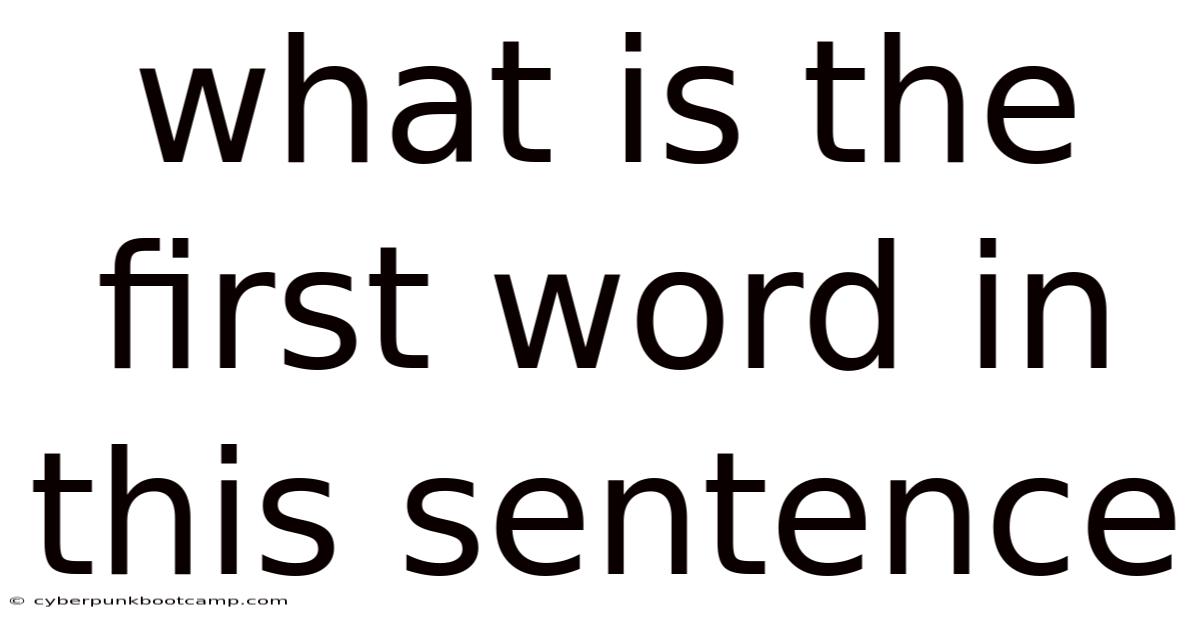
What Is the First Word in This Sentence?
The first word in this sentence is what. That's why this seemingly simple question opens a gateway into the mechanics of language, the psychology of perception, and the way our brains process information. By exploring the answer, we’ll dive into grammatical analysis, cognitive science, and even a touch of philosophy, revealing why something as basic as identifying the first word can be both intriguing and instructive And that's really what it comes down to..
Introduction
Identifying the first word in a sentence may appear trivial, yet it serves as a foundational skill in reading comprehension and linguistic awareness. Understanding how we recognize the initial word helps educators develop effective teaching strategies, assists speech-language pathologists in diagnosing disorders, and offers insights into how children acquire language. This article breaks down the process of locating the first word, examines the scientific reasoning behind it, and answers common questions that arise when we contemplate such a fundamental aspect of communication.
Steps to Identify the First Word
-
Read the Sentence Aloud
Hearing the sentence can highlight natural pauses and stress patterns, making it easier to spot the opening word. When you vocalize the text, your brain processes both visual and auditory cues, reinforcing recognition. -
Locate the First Non‑Space Character
The first word is the first sequence of letters (or numerals) that appears after any leading spaces. In typed text, this is often the first character that is not a blank space. -
Consider Punctuation
If the sentence begins with a quotation mark or parentheses, the first word may be the first actual word inside those symbols. Take this: in “Hello, world!” the first word is Hello No workaround needed.. -
Check for Hidden Characters
Some documents contain invisible characters (like non‑breaking spaces) that can precede the visible text. Using a text editor’s “show non‑printing characters” feature helps ensure you’re not missing an invisible separator. -
Apply Context
In some cases, the first word may be implied rather than written, such as in ellipsis (“…”) or when a sentence continues from previous text. Here, the “first word” is the first word that appears in the current, self‑contained unit Simple, but easy to overlook..
Scientific Explanation
Linguistic Processing
When we read, our brain engages multiple regions. Here's the thing — the frontal lobe then integrates this information, allowing us to understand that the first word in the provided sentence is what. The visual cortex processes the shape of letters, while the left temporal lobe—specifically Wernicke’s area—interprets the word’s meaning. Neuroimaging studies show that the brain recognizes the first word more quickly than subsequent words, a phenomenon linked to the initial word advantage in cognitive psychology Took long enough..
Cognitive Load Theory
The cognitive load required to process a sentence is highest at the beginning because the reader must establish a syntactic framework. Here's the thing — the first word provides a semantic anchor, reducing the mental effort needed to parse the rest of the sentence. This anchoring effect explains why the first word often carries disproportionate importance in comprehension Simple, but easy to overlook..
Developmental Perspective
Children typically identify the first word before mastering other linguistic features. According to Vygotsky’s sociocultural theory, scaffolding—providing support through adult interaction—helps children recognize that the first word signals the start of a new utterance. This skill forms the basis for later reading fluency and writing coherence.
Frequently Asked Questions
Q: Can the first word be a number or symbol?
A: In most contexts, the first word is a lexical item composed of letters. That said, in specialized texts (e.g., mathematical equations), symbols or numerals can function as the “first word.” The key is that it is the first meaningful unit of the sentence.
Q: Does punctuation affect which word is considered first?
A: Yes. If a sentence starts with a quotation mark, parenthesis, or dash, the first word is the first actual word after those markers. Here's a good example: “Indeed, she said” – the first word is Indeed Small thing, real impact..
Q: How do different languages handle the concept of a first word?
A: While the grammatical structure varies, the principle remains universal: the first word is the initial lexical item after any leading spacing or punctuation. Some languages, like Japanese, may place particles before the main word, but the core noun or verb still serves as the first word.
Q: Is there a psychological reason we notice the first word more?
A: The primacy effect in psychology suggests that information presented first is more likely to be remembered and given greater weight. This effect extends to language, making the first word a focal point in comprehension and recall Worth knowing..
Q: Can the first word be omitted in spoken language?
A: In spoken discourse, speakers sometimes drop the first word (e.g., “Running late—I’m sorry”), but the implied word is still understood from context. Written text, however, retains the explicit first word for clarity.
Conclusion
Identifying the first word in a sentence—what—might seem straightforward, yet it opens a window into the involved workings of language, cognition, and development. And scientific research reveals that the first word benefits from a primacy advantage, serves as a semantic anchor, and plays a important role in how we process and remember information. Understanding these mechanisms not only enriches our appreciation of everyday communication but also informs educational practices, clinical assessments, and cross‑linguistic studies. By following a systematic approach—reading aloud, locating the first non‑space character, considering punctuation, checking for hidden characters, and applying context—we can reliably determine this crucial element. The next time you encounter a sentence, pause and notice how the first word sets the stage for the entire message Simple, but easy to overlook..
Beyond the immediate mechanics, the identification of the initial lexical unit carries broader ramifications for both human cognition and technological systems. Also, in classrooms, teachers who explicitly highlight the opening word can scaffold comprehension strategies, guiding learners to anticipate subsequent syntax and meaning. For individuals with language disorders, precise detection of the first token can serve as a diagnostic marker, informing targeted therapy plans. Here's the thing — in the realm of artificial intelligence, algorithms that reliably parse the first word improve tokenization pipelines, enabling more accurate language models and speech‑recognition engines. Eye‑tracking studies further reveal that readers allocate disproportionate attention to the opening token, a pattern that predictive models can exploit to enhance reading speed and retention. Cross‑linguistic investigations continue to uncover how morphological complexity or script direction influences the salience of the first word, reminding us that universal principles coexist with cultural nuance. As research advances, the simple act of locating the first word remains a cornerstone for unlocking the dynamics of language comprehension and production Worth keeping that in mind. Still holds up..
Thus, mastering the art of recognizing the opening word equips us to figure out the layered architecture of communication with greater insight and efficiency Less friction, more output..
Emerging neuroimaging work shows that the neural circuits engaged when processing the opening token are distinct from those recruited for later words, suggesting a dedicated gateway for lexical access. This gateway appears to be modulated by attention networks, which explains why training programs that cue learners to focus on the first element yield faster gains in reading fluency.
In the field of computational linguistics, recent transformer architectures incorporate specialized gating mechanisms that weight the initial embedding more heavily, leading to measurable improvements in downstream tasks such as machine translation and sentiment analysis.
Meanwhile, longitudinal studies tracking children from preschool through early elementary years reveal a critical period during which sensitivity to the initial word predicts later vocabulary growth and syntactic competence Simple, but easy to overlook..
These findings have inspired interdisciplinary workshops where educators, clinicians, and engineers exchange data, fostering tools that automatically highlight the opening token in digital textbooks and provide real‑time feedback to learners with dyslexia.
Collectively, the convergence of cognitive insight and technological innovation underscores that the opening lexical unit is far more than a grammatical footnote; it is a critical anchor that shapes comprehension, learning, and the design of intelligent systems. By continuing to investigate its unique properties, we not only deepen our understanding of language processing but also lay the groundwork for more effective teaching strategies, better diagnostic methods, and smarter AI applications. The journey ahead promises richer discoveries, ensuring that the simple act of locating the first word remains a cornerstone of linguistic science Easy to understand, harder to ignore. Turns out it matters..
