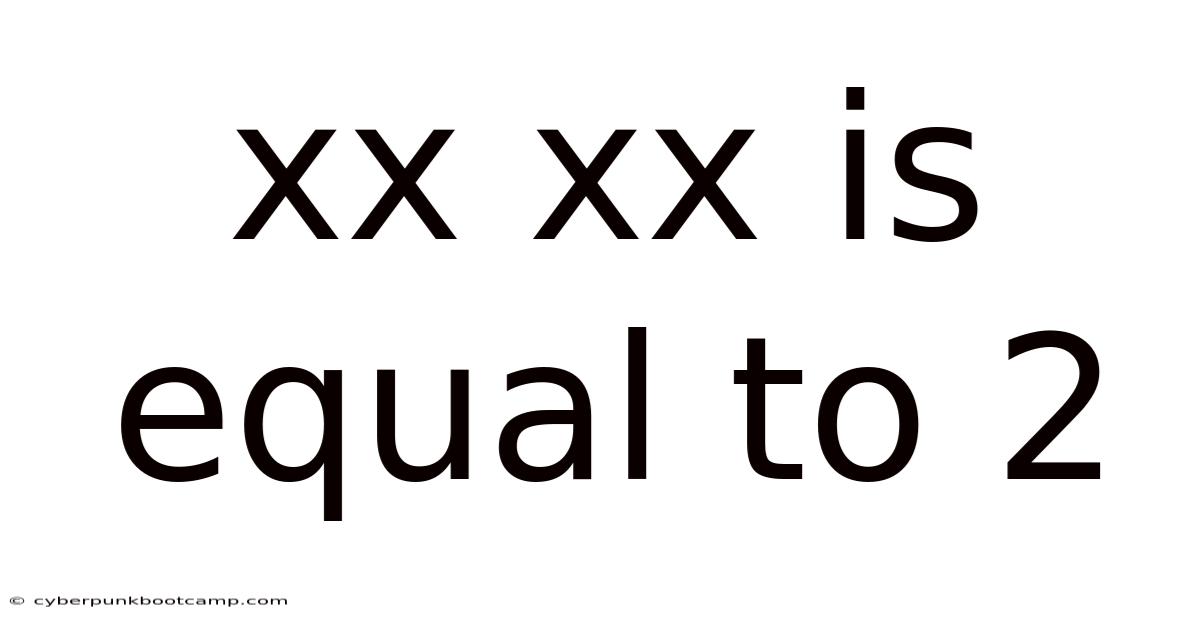
The notation “xx xx” might appear cryptic at first glance, but in the language of algebra, it represents a fundamental concept: multiplication through juxtaposition. Practically speaking, when variables are written side-by-side without an explicit operator, the implied operation is multiplication. That's why, the expression xx xx translates directly to $x \times x \times x \times x$, or $x^4$. The equation $x^4 = 2$ asks a deceptively simple question: *What number, multiplied by itself four times, equals two?
This article provides a comprehensive exploration of this equation. We will move beyond the basic real-number solution to uncover the complex roots, the geometric interpretation on the complex plane, the algebraic structure of radicals, and even a fascinating detour into an alternative interpretation: the transcendental equation $x^x = 2$.
The Real Solution: The Fourth Root of Two
The most immediate answer lies in the realm of real numbers. We are looking for the principal fourth root of 2, denoted as $\sqrt[4]{2}$ or $2^{1/4}$.
Numerical Approximation
Since 2 is not a perfect fourth power (like 1, 16, or 81), the solution is an irrational number. It cannot be expressed as a simple fraction, and its decimal expansion continues infinitely without repeating.
$x = \sqrt[4]{2} \approx 1.189207115002721\dots$
We can verify this: $1.Think about it: 4142 \quad (\text{which is } \sqrt{2})$ $1. That's why 1892^2 \approx 1. 4142^2 \approx 2.
This reveals a beautiful nested relationship: The fourth root of 2 is the square root of the square root of 2. $\sqrt[4]{2} = \sqrt{\sqrt{2}} = 2^{1/4}$
Historical Context: The Delian Problem Connection
The quest for $\sqrt[4]{2}$ echoes the famous Delian Problem (doubling the cube), which required constructing $\sqrt[3]{2}$ using only a compass and straightedge. The ancient Greeks proved that cube roots are generally impossible to construct with those tools alone Which is the point..
What about the fourth root? In real terms, construct a segment of length 2. 3. Construct $\sqrt{2}$ (the diagonal of a unit square). Here's the thing — **
- Because $\sqrt[4]{2} = \sqrt{\sqrt{2}}$, and square roots are constructible (via the Pythagorean theorem), **the fourth root of 2 is constructible with compass and straightedge.2. Construct $\sqrt{\sqrt{2}}$ (the geometric mean of 1 and $\sqrt{2}$).
This distinction highlights the hierarchy of constructible numbers: square roots are "easy," fourth roots are "nested easy," but cube roots and fifth roots belong to a different, non-constructible tier.
The Complete Picture: Four Complex Roots
The Fundamental Theorem of Algebra states that a polynomial equation of degree $n$ has exactly $n$ roots in the complex number system (counting multiplicity). Since our equation is $x^4 - 2 = 0$ (degree 4), there must be four distinct solutions.
We find these using polar form (Euler's formula). We express the target number 2 as a complex number with magnitude 2 and angle $0$ (or $2\pi k$): $2 = 2 \cdot e^{i(2\pi k)} \quad \text{for integer } k$
The fourth roots are given by: $x_k = 2^{1/4} \cdot e^{i(2\pi k / 4)} = \sqrt[4]{2} \cdot e^{i(\pi k / 2)} \quad \text{for } k = 0, 1, 2, 3$
Let's calculate the four roots explicitly:
- $k=0$ (The Principal Real Root): $x_0 = \sqrt[4]{2} \cdot e^{i0} = \mathbf{\sqrt[4]{2} \approx 1.189
